Thursday, December 12, 2024

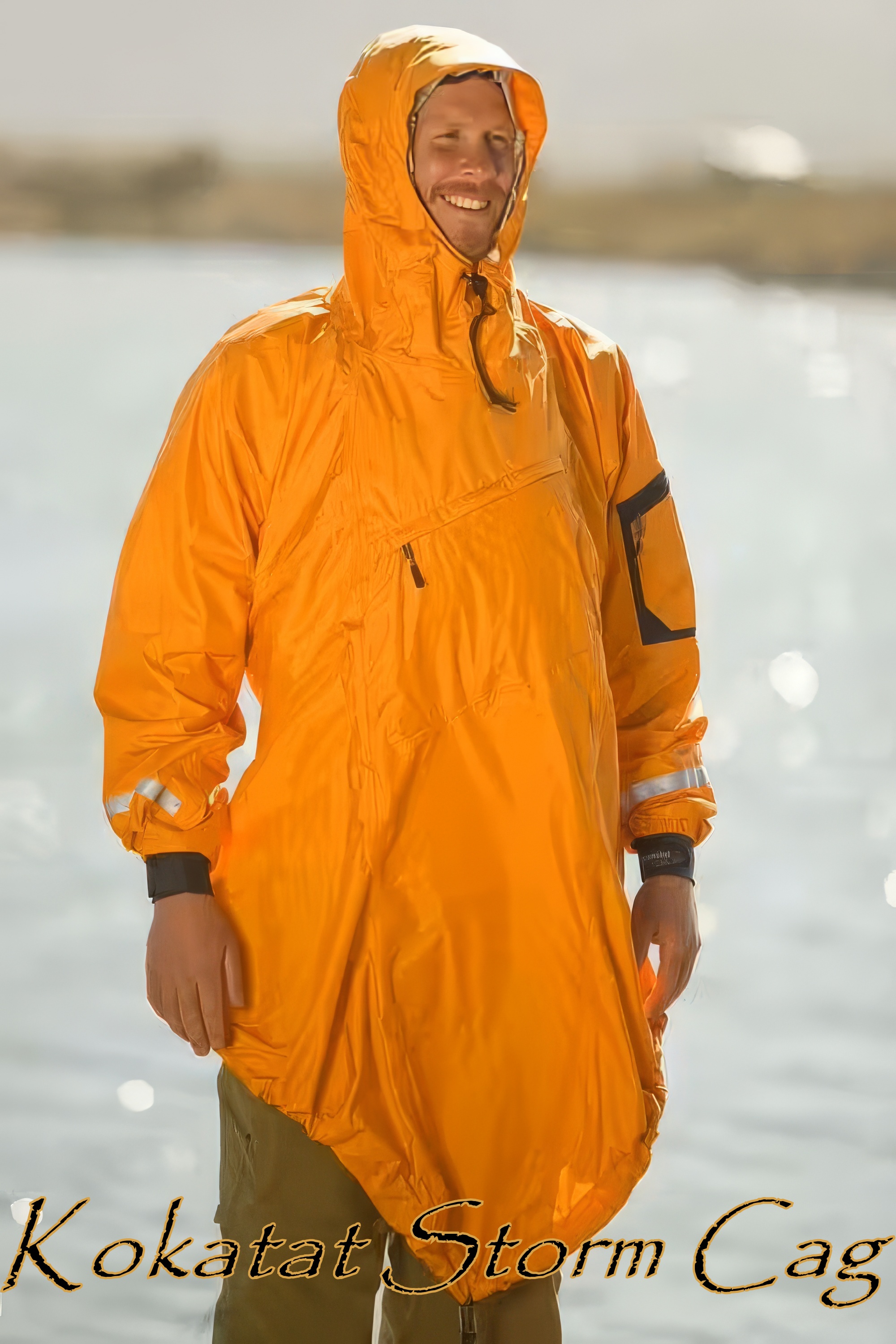
Kayak Packing Hacks - Kokatat Storm Cag


Image courtesy of Nautopp Kajakcenter Grebbstad


Paddling the Northwest Coast can be a cold and wet affair.  While all Pacific coastal residents own multiple rain jackets made of various materials that feature numerous doo-dahs that seal, vent, hood, snug and are acceptable restaurant and clubwear anywhere in North America very few of them were designed with our disease in mind.  Consequently, for paddling, all of their doo-dahs fall well short of addressing our paddling needs.  With all of the pockets, vents and adjustments they can only be worn under a PFD on the water or on the beach.  Their sole saving grace is that they help us look stylish on the shore.

Enter the Kokatat Storm Cag.  Guaranteed to look goofy on the shore and deemed acceptable clubwear only in British Columbia and Alaska it is featured on the bodies of intelligent paddlers all over North America.  It has very few doo-dahs but does have everything that we really need. 

The cut allows it to be pulled on over your immersion gear and PFD while seated in your boat and secures around the coaming of your kayak.     The adjustable hood can be used with or without a helmet.   It features a fleece-lined kangaroo handwarmer pocket with a small velcroed opening allowing you to access pockets in your PFD, There is also a zippered pocket over the kangaroo pocket that I personally find very useful.  If you unzip that pocket you can stuff the garment into it while turning it inside out, Zip that shut and you have a fleece-covered pillow for sleeping. 


The shape of the cag allows you to sit down and tuck your legs inside for warmth.  Sort of a truncated personal bothy bag.  I have bivi-ed in this garment and will attest to the added warmth it provides overall but also for your toes and feet.   


Loosely packed it is scarcely larger than a Jetboil stove and since it is flexible it will fit into a space that the Jetboil will not.  With the Storm Cag you are carrying a rain layer for paddling and for shore, a wind breaker, bothy bag and pillow.  Such a deal and a great space saver inside your kayak.   

If you don’t mind looking a tad goofy on shore, take one of these instead of your ramma-lamma dead-dinosaur GoreTex wonder jacket.  I’ve worn mine on BC Ferries, campsites and all over Prince Rupert but never once have been kicked out of a restaurant, lounge or bar.  It is the only rainwear that I pack for kayak trips. 


Wednesday, December 11, 2024

Kayak Packing Hacks - Toilet Paper

Note paperback book in the right corner of the window


How much to bring?  How little can I get away with?  My first coastal trip was with a nature boy who thought that leaves and smooth rocks were acceptable substitutes for #2 hygiene.   He didn’t bring any toilet paper at all and I quickly learned that his smooth-rock-requirement severely limited the number of beaches that we could camp on.  I felt that his Mr. Nature approach was extreme but I wanted to fit in so I pretended to go along with his plan but stole as much toilet paper as I could from the “Queen of Chilliwack’s” mensroom.  I hid this tree-wasting contraband in my boat and would only take it out when needed.  I nervously performed regular inventories and it wasn’t long before I realized that demand was outstripping supply.  What to do?   

On Day 8 I bid adieu to the very last of my secret, stolen toilet paper.  I was really depressed at the thought of what was coming next but then, miraculously, my luck changed.  I found a damp and mouse-eaten paperback book delicately balancing on the empty window frame of the dilapidated cabin on Triquet Island.  I quickly stuffed it down my pants before nature boy could see it and claim it as community fire starter,  No way was I going to share this bounty with him.  He was welcome to all of the barnacle covered rocks and cedar bows that he loved so much and of which there were many. 

At the conclusion of that trip I quit paddling with Nature Boy as I felt that I had learned everything he had to teach me and adopted my own toilet paper sensibilities which embraced "more-is-better" as a key tenet.  The problem, though, was that while TP is light it takes up a lot of space so I found a way to reduce that volume and fit it into spaces that often go to waste.  This is what works for me. 

Four Rolls in the Space of Two

Take a large leak proof bag and shove two rolls of toilet paper into it.  I use 10” wide zip locks.  Sit on the bag to smoosh the rolls and compress the paper and while still sitting on it close the airtight seal.  Now open the seal just enough to insert a straw and suck the remaining air out.  Seal the bag.  Take a length of jute or some other flammable line and tie it around the bag.  Leave a length of line on each sealed bag.  Two to three feet is probably plenty.  Tape the bag tight ensuring that the line is secured to the bag.  Don’t laugh but I pack 8 rolls this way into 4 bags.  Take a bit of colored electrical tape and put a different colored tape on the end of each line.  Red, white and blue is my go-to.  The bags will be oval and elongated.  I shove them one at a time into the very stern or bow of my boat as it is space seldom used for anything else.  Force them back there in an order so that you can remember which string to pull for the next bag of TP (hence red, white and blue).  The jute can be burned and the bags can be reused at home.  

In case you are curious about the book, by wild coincidence that paperback was “Roughing It” by Mark Twain.   I shit you not. 

Monday, November 18, 2024

Kayak Bill Camps - Dallas Island

Originally published October 17, 2017


Dallas Island was one of Bill’s primary camps.  At ~21NM from Shearwater it was midway to his camps on Aristazabal.  Dallas is located along the eastern edge of Milbanke Sound and at the entry to Finlayson Channel where it provided superb shelter and a clear view of conditions on Milbanke Sound prior to committing to crossing over to Higgins Passage.  It was a one or two day paddle from his shack on Brian Clerx’s property that he referred to as “Denny Island Camp”.  By leaving Shearwater near the turn to ebb he could get to the Ivory Island / Blair Inlet complex at the turn to flood.  This would give him a push north to Dallas for the final 7 NM.  If conditions or tides didn’t cooperate there were bivy camps scattered along Seaforth Channel and a couple of camps in Blair Inlet where he could hole up.


In 2007 Dave, Greg and I stayed at the Dallas Island Camp.  Bill had spent eight days here in June 2003 on his way out to his more remote camps and had spent two more nights in October on his way back to Denny Island Camp.  He was headed back to Shearwater to do some painting and resupply for what would turn out to be his last trip.  He had just two months to live. 

Monday, August 12, 2024

Bivi at Safety Cove


On day 14 of our 2023 trip from Klemtu to Port Hardy Dave Resler and I ended up at a place called Safety Cove on east side of Calvert Island.  That came at the end of a 22-mile day grinding against rain driven by 15 kt headwinds and a moderate sea state.  Hard work in snotty conditions.  We figured that with a name like Safety Cove we would find a decent place to camp.  We had earned it but no such luck.  What we found was a sliver of high slope shell “beach” that would barely survive the 12.4’ high tide while providing no room for tents.  The backing forest was impenetrable.  There were two big logs that we could sit between in an upright fetal position, so I strung my tarp over them.  It was tight but would have to do. 

This was to be a wet, windy drysuit bivi in our PFD’s, hooded Storm Cags, wool hats, and spray skirts around our necks for added insulation.  I pulled the foam seat from the Grand Illusion to insulate my butt and put on my last dry Glacier Gloves.  We piled all our drybags on top of our legs and spread Dave’s ultralight tarp over us for a blanket.  It felt OK for about 30 minutes. 

The cold wind and rain continued through the night and, having firsthand experience with hypothermia, I monitored my temperature closely.  Shortly before sunrise the wind dropped, the rain stopped, and I actually fell asleep for 30 minutes or so. 

Not the worst night I have spent on the BC coast but still earns a rating of Type III fun.


Thursday, February 29, 2024

Never Turn Your Back on the Sea


Honolulu’s own Duke Paoa Kahinu Mokoe Hulikohola Kahanamoku is recognized as the  Father of Surfing and during his life gained worldwide popularity as an Olympic swimmer, all round waterman and humble philosopher.  Many popular quotes track back to him during his 77 years and maybe the most famous is “Never turn your back on the ocean”. 

Duke Kahanamoku
1910 - Library of Congress - 10653

The late, great Eric Soares was a spectacular modern-day waterman in his own right.  Co-founder and Commander of the Tsunami Rangers he and his crew introduced the world to a gonzo sea kayaking discipline that is called Rock Gardening.  While Eric departed this plane in 2012, he left us with his Ten Commandments of Sea Kayaking.  Knowing a good idea when he heard it he borrowed from Duke and his First Commandment is “Never turn your back on the sea”. 

Eric Soares
copyright Michael Powers

Monday, September 11, 2023

Klemtu 2 Port Hardy 2023


After six years of retirement preparations, Covid restrictions and the business of selling our house, buying a new one and moving to Everett it was time to return to the BC coast and the Great Bear Rain Forest.  It had been even longer for my paddling partner, Dave Resler, who made it clear that he was going, no matter what.  All he asked me to do was all the planning and preparations.  Piece of cake, right? 

Honestly, I wasn’t convinced that he would really be able to go so I put off planning longer than I normally would have and when I did start I found that all of my nautical charts and charting tools had disappeared in our move.  Unbelievable!  I bought enough replacements to cover the waters between Port Hardy and Caamano Sound as I figured that I could come up with something interesting there but then found that Garmin had discontinued support for Homeport, the charting program I use.  Double unbelievable!  I had lost significant functionality in their decision to cast me aside but figured out enough workarounds to where I could get by. 

With my new charts and crippled Homeport application I decided to create a trip that would be familiar yet have enough new twists and turns to be interesting.  I felt that it would be most efficient (and fun) to ferry up to Klemtu and paddle back to Port Hardy by whatever route struck our fancy and that the conditions would accommodate.  Most of our “planned” campsites were just options and not hard and fast daily destinations.  Heresy, for some, but that's how I roll.  It would be a vague route that would allow us to change with the wind.  The chart work took me a couple of months of consistent work to complete. 

After losing all of my charts, finding my charting program “broken”, several of my dry bags delaminated, battery cases rusted shut, some safety gear expired or worn out and other key gear missing in action I shouldn’t have assumed that I was through the “broken phase” of the trip.  And I wasn’t. 

Dave had a new Garmin Mini 2 that would allow limited texting.  Since this brought a new expectation to our trips and because I was sensing that there might be some communication issues regarding conditions, movement, etc. I asked local paddler, mentor and all around good guy, Bill Porter, to act as our interpreter when and if a message really needed clarification and the guy who would handle things if we really needed help. 

This is the story of the Carhartt Duct Tape Tour.

Thursday, June 1, 2023

Joey-Walks-with-White-Feet


Originally published December 2019

A significant storm approached as we were exiting Gale Passage.  Gale bisects the Bardswell Group and opens into Thompson Bay which faces south into the open Pacific.  If you were to continue south from Thompson Bay your first landfall would be Antarctica.  That is a hard-to-comprehend amount of fetch and while this storm wasn’t being driven by some historic low-pressure system that movies are made of it was big enough to get every sea-going vessel’s attention and it was going to make Thompson Bay an unfriendly environment to the extreme.  There may have been good places to hide from a storm in the bay but they were hiding from us and were not marked on our charts with the exception of Cree Point and Islet 48 which lay another 3 NM upwind from Cree.  Dave and I had previously stayed at the Heiltsuk cabin on Quinoot Point located 2 NM in the wrong direction and downwind from Cree.  We viewed it as our last resort option.  We thought that, if need be, we could probably slip through the backdoor route between Dufferin and Potts Islands that is blocked at low tides and requires a slippery and ankle breaking portage.