Showing posts with label Articles. Show all posts

Saturday, October 3, 2026

Kayaking Hacks ~ The Throwing of Sticks

In many parts of the kayaking world the choosing of a tent site is easy business.  Expansive dry beaches or open uplands make it a simple thing to set up a tent and have a pleasant night’s sleep.  In such locations if you wish to put some space between you and your trip partner(s) you can simply take a stroll and choose a place that is flatter, softer, firmer, has more sun, more shade, is more spacious, more intimate or maybe just out of range of their snoring.  In that perfect camping world, there are no losers because everybody gets a great tent site.  Everybody wins. 

Elbow Camp ~ Meyers Passage

Unfortunately, where I travel, less than ½ the beaches allow for everyone to win the Tent Site Lotto so we have come up with something that works for us and we call it The Throwing of Sticks.  A tent site is claimed when a paddler thows a stick on a site and says "I throw my stick".  This throwing is done in a predetermined order.  

Clifford Bay ~ 52˚34'16"N   129˚08'52"W

Invented by my trip partner, Dave Resler, it is used for determining the daily order of choosing tent sites.  At the put-in we play Rock-Paper-Scissors to determine the order of Throwing Sticks and it remains in place until the end of the trip.  When landing at a potential campsite a quick assessment is made to determine if decent tent sites are plentiful or if stick throwing needs to be invoked.   If good ones are scarce, each paddler picks up a stick and walks the beach.  The paddler with first choice throws their stick down on the spot he/she wants to claim.  Then, number two throws followed by number three, etc.  Once all sticks have been thrown any paddler is free to pick up their stick and choose a different unclaimed tent site.  The next day, camper number two gets to throw first.  The day after that belongs to camper three.  If a paddling day ends at a beach so sweet that every spot is a winner and no stick throwing is required the order is carried over a day or until a less than stellar campsite is encountered.  

A veteran tip for new players is to know that there is a bit of gamesmanship involved for the paddlers early, but not first, in the order.  For instance, if you throw second or third you want to take your time in prioritizing your choices and not tip your hand.  You may see something in a tent site that the paddler throwing ahead of you doesn't notice.  If you fawn over your first choice and stand in it before your turn others may take a closer look at it and choose it before you get the chance to.  Just sayin'.

Crap Camp ~ 53˚22'59"N   130˚16'01"W

Sometimes a stick thrower may claim an upland site that isn't a site at all but appears to be more level or require less clearing.  At Crap Camp on Banks Island there wasn't a single site above high tide large enough for a two-man tent.  It was Dave's turn to throw first so he claimed the only level spot on the 15 meter wide beach.  It was above the driftwood and only large enough for his tent to be partially spread, but it was the best site.  I was second so I picked an uneven sloping spot atop a pile of logs pressed tight against the rocks lining the beach.  It was way too small for my Hubba Hubba but was the second-best tent site in our tiny cove.  There was no third spot left large enough for Greg's one-man tent, so he had to sit in the rain and wait until the tide ebbed sufficiently to allow enough wet sand between the driftwood and water for him to set up. 

Safety Cove ~ 51˚32'07"N   127˚54'30"W

The three of us have covered a lot of miles together on the outer BC coast and Edge of Great Bear route.  I suspect that without our stick-throwing-code we would have killed and eaten each other just to make it easier to set up camp. 


Monday, January 19, 2026

Morning on Cockle Bay


We bedded down for the night in the large Heiltsuk cabin on Cockle Bay.  In the morning, we planned for a short 9 mile paddle to Gale Passage where we would spend the night.  From there, Greg would leave and paddle 16 miles solo to catch the ferry at Bella Bella while Dave and I carried on to Port Hardy. 

Since our planned mileage to Gale Passage was modest I had anticipated sleeping late so I was surprised to be wakened by Greg before sunrise.  He had been up a while drinking coffee and relaxing on the front porch but was now bent over my bunk with a finger to his lips signaling me to be quiet.  He whispered that he heard something walking on the rock shelf in front of the cabin.  He thought it might be a wolf. 

I slipped out of my sleeping bag and we tiptoed across the rough, uneven floorboards to the deck where we sat in the dark and calibrated our ears to the pre-dawn silence.  Listening carefully, we could just make out the faint footfall of an animal walking on the shelf out of sight to the left of the cabin. 

Soon, a wolf came into view, head down, intent on scavenging the tide line.  We held our breath and didn't move yet the wolf sensed our presence, looked up at us and froze a moment before his posture changed to prepare for flight.   He glanced back from where he had come and then walked quickly past us looking back as he went.  We heard the soft sound of more paws on the rock to the left and another pair of smaller wolves stepped in front of the cabin.  They quickly spotted us and took off back the way they had come. 

The larger wolf sat on the beach 50 meters to our right and began to howl.  The smaller pair answered him.  I had heard wolves before but these didn’t sound like anything I had ever experienced before.  Back and forth they called in an eerie, otherworldly language.  We could hear the smaller pair calling as they moved through the forest behind the cabin.  Soon, they joined their alpha and went about their business. 


I've never had a single bad morning on Cockle Bay.


Wednesday, July 30, 2025

Morning at Baker Point


We crossed CaamaƱo Sound to Aristazabal Island beneath thick fog and rising winds that would hit 25 knots before day's end. Landing in the lee of Baker Point before things got too sporty, we scouted for a campsite and found a small forest clearing—coated in eagle poop and barely big enough for one, maybe two tents. None of us fancied sleeping in that mess, so we opted for the logs instead. The weather radio warned of sustained northwesterly winds at 25 to 35 knots for the next couple of days.  It howled through the night.

Around 3:30 AM I got up to pee and assess the weather.  Crawling out of my tent I stepped towards the beach and on to something soft and alive.  Looking down, my headlight illuminated more toads than I had ever seen before.  The ground was covered with them feasting on insects that had come out of the beach detritus.  Stepping carefully, I walked forward towards the water until I was in a no toad zone.


I stood there and did my business while looking the four miles across Laredo Channel to where the mountains of Princess Royal Island were backlit with the dark rose promise of sunrise.  The sound of the wind in the trees and the chattering of the whitecapped seas provided the soundtrack as I looked straight up at black sky that was jampacked with stars. Suddenly a large yellow/orange meteor came into my vision from behind the trees on a NE heading.  It was colorful and shedding fiery debris, seemingly slow-moving and just before reaching the horizon, it faded and disappeared. 

After that I couldn't sleep so I fired up my Jet Boil to make coffee.  At the sound of my stove Greg crawled from his tent as he can never pass up the possibility of a cup coffee. 

Perched on a log, coffee in hand, we spoke of wind and water and toads and meteors while watching the sunrise paint the morning sky.

Thursday, December 12, 2024

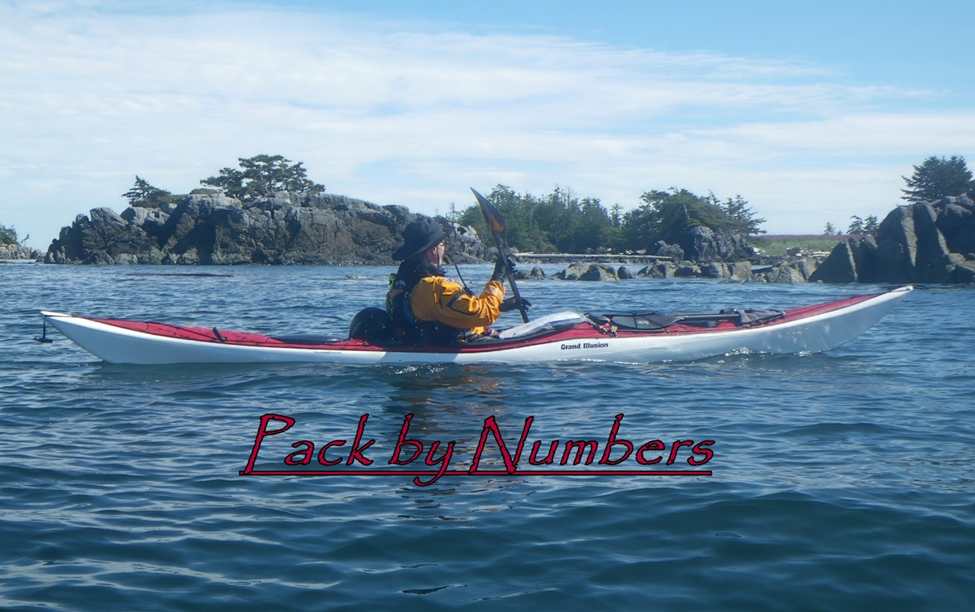
Kayaking Hacks ~ Pack by Numbers

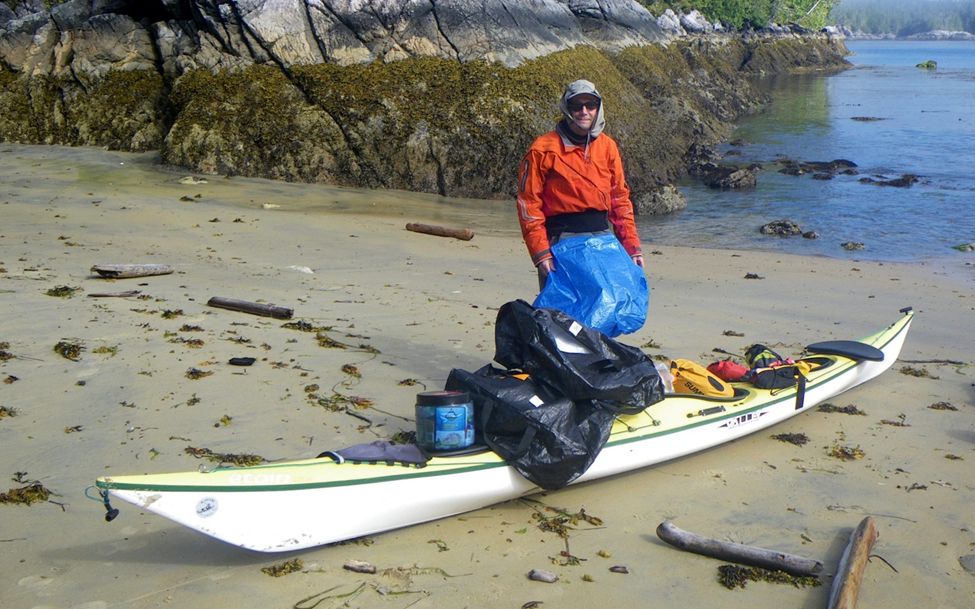
Loaded and trimmed for 3 1/2 weeks

As with all things kayaking, folks have found different solutions that work for them and have differing opinions.  Sometimes the solutions are well conceived and other times not-so-much.  I’m going to discuss my method of packing for a kayaking trip for a single overnight or for a month at a time.  Since I’ve never been out for more than a month my experience hits a wall at that point.  This is what works for me.

My first rule is no deck loading.  The only kit on the deck will be a spare paddle, chart case, GPS and helmet.  Nothing but navigation and safety gear.  There is an issue with windage that comes with deck loading but for me it is about safety and deck access.  When things go sideways that deck may be your only friend and savior.  If it is cluttered with bags, carts and furniture safety can be severely compromised.  My helmet is the only item on the back deck and it is attached in a manner that allows it to be easily removed and discarded if in the way.   


Basics: 

  • Take only what you are really going to need.  
  • Know what every item weighs and distribute the weight so that the boat retains its empty balance.  In other words, it is not stern or bow heavy unless you know from personal experience that it performs better in ALL conditions when loaded in an unbalanced state.
  • Place heavy items closer to the cockpit with lighter items towards the bow and stern. 
  • In your kit selection prioritize packed size over weight. 
  • There should be no unsecured gear in the cockpit. 
  • If you can’t fit it in the hull set it aside for now as you probably don’t need it. 


Take only what you need:

  •  Bring basic clothing.  No extra stuff.  This ain’t no party, this ain’t no disco, this ain’t no fooling around.  Don’t worry about having the perfect layer. 
  • Choose clothing and gear that serves multiple purposes when possible.   If you have a Storm Cag you don’t need a separate raincoat and how many different shoes do you really need?.   
  • Don’t try to pack clean clothes for each day.  That takes up too much space. 
  • Accept that you are going to get dirty and you are going to stink.  Wool stinks less than synthetics.

Gear weight: 

  • Some folks try to color code their drybags or label them with hangtags that describe the contents.  Good ideas and those are nice-to-haves but not gotta-haves.  The gotta-have is how much does each bag or loose item weigh.
  • I use mostly small and/or compression drybags with two tapered bags with purge valves for bow and stern.
  • Once you have all of your necessary gear assembled and bagged, weigh each item and record that on a spreadsheet. 


Start packing it into the boat where it makes sense to you while being mindful of “heavy-to-the-center-light-to-the ends.  Did it all fit INSIDE the hull?  Check your spreadsheet to see how close to balanced are you? Start figuring out what items need to go fore or aft based on weight, size and shape to achieve balanced trim while fitting INTO the hull.  It may take you a while to get the weight properly placed to achieve trim. 

  • Didn’t all fit?  OK, start figuring out what your nice-to-haves are and set them aside.   Keep working at it until you have fit all of your gotta-haves INSIDE the boat in a balanced fashion. If you find room for a nice-to-have that’s a score! 
  • Figure out how much water you REALLY need to carry and put it into bags.  I prefer the MSR Dromedary Bags but others work well and they conform to available spaces.   Plastic water bottles are inefficient as they don’t conform and take up as much space empty as they do when full. 
  • Don’t carry more water than you need.  I seldom carry more than I will personally need for two or three days though I take a 10-liter, 6-liter and 4-liter bag for clean, filtered water.  With my filter I pack two dirty-water collection bags which combined packs smaller than a 2 liter Nalgene bottle.
  • Know that a 10-liter bag holding only 4-liters will fit into spaces that a 4-liter bag will not. Empty Dromedary Bags take up very little space, essentially the size of their non-conformable cap.  Water weighs about 2 pounds per liter and bags can be moved around to balance your boat.  It’s a puzzle.  It’s all about space!

It all fits INSIDE the hull

Practice!!!!!: 

  • Now that you are balanced and have fit your gotta-haves INSIDE the hull start practicing packing and unpacking. 
  • Have two beach bags.  Large Ikea bags are great as they are cheap, light and take up nearly zero space when empty.  Use one for the cockpit forward and one for behind the cockpit.
  • Practice until each item is always in the same place and you can pack fast with or without daylight.  When you have performed enough reps to be efficient you will know exactly what is inside every bag by location and feel and won’t need color-coding or labels.  Once you have practiced enough that you know what each item is and where it lives, practice some more. 
  • Have some spare time before dinner?  Great! Go out into the garage and practice some more.

Stages of packing

You never want to be the last person packed and off the beach because you are fidgeting with your gear and trying to figure out where everything goes.  There are many people that you don’t want to be in this life and the last person off the beach is one of them.  


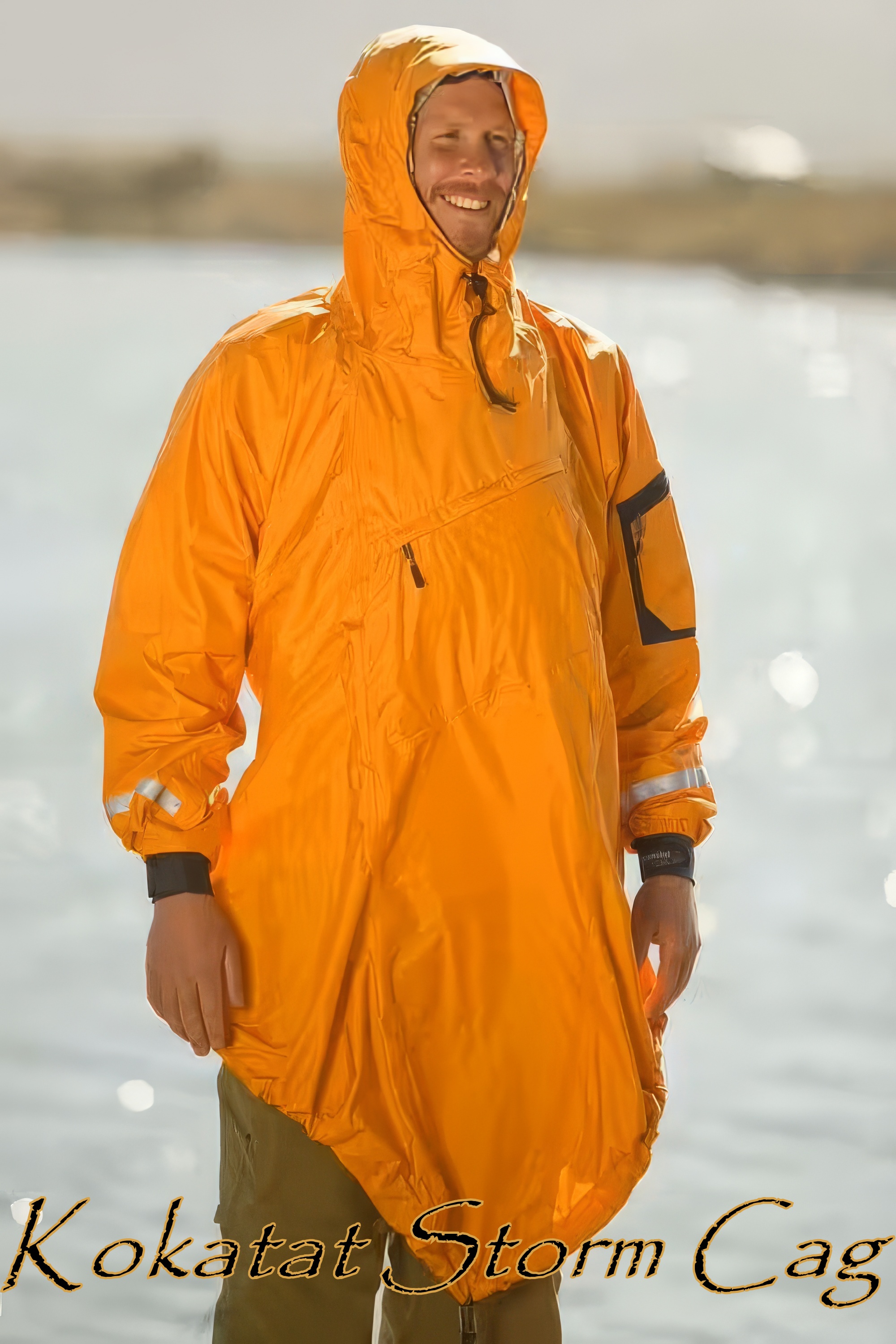
Kayaking Hacks - Kokatat Storm Cag


Image courtesy of Nautopp Kajakcenter Grebbstad


Paddling the Northwest Coast can be a cold and wet affair.  While all Pacific coastal residents own multiple rain jackets made of various materials that feature numerous doo-dahs that seal, vent, hood, snug and are acceptable restaurant and clubwear anywhere in North America very few of them were designed with our disease in mind.  Consequently, for paddling, all of their doo-dahs fall well short of addressing our paddling needs.  With all of the pockets, vents and adjustments they can only be worn under a PFD on the water or on the beach.  Their sole saving grace is that they help us look stylish on the shore.

Enter the Kokatat Storm Cag.  Guaranteed to look goofy on the shore and deemed acceptable clubwear only in British Columbia and Alaska it is featured on the bodies of intelligent paddlers all over North America.  It has very few doo-dahs but does have everything that we really need. 

The cut allows it to be pulled on over your immersion gear and PFD while seated in your boat and secures around the coaming of your kayak.     The adjustable hood can be used with or without a helmet.   It features a fleece-lined kangaroo handwarmer pocket with a small velcroed opening allowing you to access pockets in your PFD, There is also a zippered pocket over the kangaroo pocket that I personally find very useful.  If you unzip that pocket you can stuff the garment into it while turning it inside out, Zip that shut and you have a fleece-covered pillow for sleeping. 


The shape of the cag allows you to sit down and tuck your legs inside for warmth.  Sort of a truncated personal bothy bag.  I have bivi-ed in this garment and will attest to the added warmth it provides overall but also for your toes and feet.   


Loosely packed it is scarcely larger than a Jetboil stove and since it is flexible it will fit into a space that the Jetboil will not.  With the Storm Cag you are carrying a rain layer for paddling and for shore, a wind breaker, bothy bag and pillow.  Such a deal and a great space saver inside your kayak.   

If you don’t mind looking a tad goofy on shore, take one of these instead of your ramma-lamma dead-dinosaur GoreTex wonder jacket.  I’ve worn mine on BC Ferries, campsites and all over Prince Rupert but never once have been kicked out of a restaurant, lounge or bar.  It is the only rainwear that I pack for kayak trips. 


Wednesday, December 11, 2024

Kayaking Hacks - Toilet Paper

Note paperback book in the right corner of the window


How much to bring?  How little can I get away with?  My first coastal trip was with a nature boy who thought that leaves and smooth rocks were acceptable substitutes for #2 hygiene.   He didn’t bring any toilet paper at all and I quickly learned that his smooth-rock-requirement severely limited the number of beaches that we could camp on.  I felt that his Mr. Nature approach was extreme but I wanted to fit in so I pretended to go along with his plan but stole as much toilet paper as I could from the “Queen of Chilliwack’s” mensroom.  I hid this tree-wasting contraband in my boat and would only take it out when needed.  I nervously performed regular inventories and it wasn’t long before I realized that demand was outstripping supply.  What to do?   

On Day 8 I bid adieu to the very last of my secret, stolen toilet paper.  I was really depressed at the thought of what was coming next but then, miraculously, my luck changed.  I found a damp and mouse-eaten paperback book delicately balancing on the empty window frame of the dilapidated cabin on Triquet Island.  I quickly stuffed it down my pants before nature boy could see it and claim it as community fire starter,  No way was I going to share this bounty with him.  He was welcome to all of the barnacle covered rocks and cedar bows that he loved so much and of which there were many. 

At the conclusion of that trip I quit paddling with Nature Boy as I felt that I had learned everything he had to teach me and adopted my own toilet paper sensibilities which embraced "more-is-better" as a key tenet.  The problem, though, was that while TP is light it takes up a lot of space so I found a way to reduce that volume and fit it into spaces that often go to waste.  This is what works for me. 

Four Rolls in the Space of Two

Take a large leak proof bag and shove two rolls of toilet paper into it.  I use 10” wide zip locks.  Sit on the bag to smoosh the rolls and compress the paper and while still sitting on it close the airtight seal.  Now open the seal just enough to insert a straw and suck the remaining air out.  Seal the bag.  Take a length of jute or some other flammable line and tie it around the bag.  Leave a length of line on each sealed bag.  Two to three feet is probably plenty.  Tape the bag tight ensuring that the line is secured to the bag.  Don’t laugh but I pack 8 rolls this way into 4 bags.  Take a bit of colored electrical tape and put a different colored tape on the end of each line.  Red, white and blue is my go-to.  The bags will be oval and elongated.  I shove them one at a time into the very stern or bow of my boat as it is space seldom used for anything else.  Force them back there in an order so that you can remember which string to pull for the next bag of TP (hence red, white and blue).  The jute can be burned and the bags can be reused at home.  

In case you are curious about the book, by wild coincidence that paperback was “Roughing It” by Mark Twain.   I shit you not. 

Monday, August 12, 2024

Bivi at Safety Cove


On day 14 of our 2023 trip from Klemtu to Port Hardy Dave Resler and I ended up at a place called Safety Cove on east side of Calvert Island.  That came at the end of a 22-mile day grinding against rain driven by 15 kt headwinds and a moderate sea state.  Hard work in snotty conditions.  We figured that with a name like Safety Cove we would find a decent place to camp.  We had earned it but no such luck.  What we found was a sliver of high slope shell “beach” that would barely survive the 12.4’ high tide while providing no room for tents.  The backing forest was impenetrable.  There were two big logs that we could sit between in an upright fetal position, so I strung my tarp over them.  It was tight but would have to do. 

This was to be a wet, windy drysuit bivi in our PFD’s, hooded Storm Cags, wool hats, and spray skirts around our necks for added insulation.  I pulled the foam seat from the Grand Illusion to insulate my butt and put on my last dry Glacier Gloves.  We piled all our drybags on top of our legs and spread Dave’s ultralight tarp over us for a blanket.  It felt OK for about 30 minutes. 

The cold wind and rain continued through the night and, having firsthand experience with hypothermia, I monitored my temperature closely.  Shortly before sunrise the wind dropped, the rain stopped, and I actually fell asleep for 30 minutes or so. 

Not the worst night I have spent on the BC coast but still earns a rating of Type III fun.


Thursday, February 29, 2024

Never Turn Your Back on the Sea


Honolulu’s own Duke Paoa Kahinu Mokoe Hulikohola Kahanamoku is recognized as the  Father of Surfing and during his life gained worldwide popularity as an Olympic swimmer, all round waterman and humble philosopher.  Many popular quotes track back to him during his 77 years and maybe the most famous is “Never turn your back on the ocean”. 

Duke Kahanamoku
1910 - Library of Congress - 10653

The late, great Eric Soares was a spectacular modern-day waterman in his own right.  Co-founder and Commander of the Tsunami Rangers he and his crew introduced the world to a gonzo sea kayaking discipline that is called Rock Gardening.  While Eric departed this plane in 2012, he left us with his Ten Commandments of Sea Kayaking.  Knowing a good idea when he heard it he borrowed from Duke and his First Commandment is “Never turn your back on the sea”. 

Eric Soares
copyright Michael Powers

Thursday, June 1, 2023

Joey-Walks-with-White-Feet


Originally published December 2019

A significant storm approached as we were exiting Gale Passage.  Gale bisects the Bardswell Group and opens into Thompson Bay which faces south into the open Pacific.  If you were to continue south from Thompson Bay your first landfall would be Antarctica.  That is a hard-to-comprehend amount of fetch and while this storm wasn’t being driven by some historic low-pressure system that movies are made of it was big enough to get every sea-going vessel’s attention and it was going to make Thompson Bay an unfriendly environment to the extreme.  There may have been good places to hide from a storm in the bay but they were hiding from us and were not marked on our charts with the exception of Cree Point and Islet 48 which lay another 3 NM upwind from Cree.  Dave and I had previously stayed at the Heiltsuk cabin on Quinoot Point located 2 NM in the wrong direction and downwind from Cree.  We viewed it as our last resort option.  We thought that, if need be, we could probably slip through the backdoor route between Dufferin and Potts Islands that is blocked at low tides and requires a slippery and ankle breaking portage. 


Saturday, October 1, 2022

Marcel Speaks


Originally published 4/21/2021

On my second day of skiing I participated in a series of bad decisions that nearly cost me and my friends our lives.  Being in high school at the time when bad ideas and bad decisions were a way of life the only thing that is surprising is that we survived.  Without belaboring details let me just say that we had gotten lost and were suffering from hypothermia.  We were rescued by three remarkable men, two of whom told me years later that when they found us, we had maybe 2 hours to live.  Two of those men were very kind but the third was a beast.  

The beast was a German expat named Marcel Schuster who had served on the Russian Front in WWII as a Nazi Mountain Trooper.  He was captured and spent three years in a POW camp which didn’t make him a nicer person.  He was entirely unpleasant and totally unsympathetic to our situation.  During our rescue the only six words he uttered to us were “You Stoopid Boyzzz” and “Learn or Die” followed by another “You Stoopid Boyzzz”.  After eight years I was reunited with the three men who I owed my life to and Marcel didn’t smile and wouldn’t shake my hand.  All he said while looking at me with a cold and bitter stare was “You Stoopid Boyzzz”.  

I’m going to get to the kayaking part in a minute but before I do I want to mention what a strong influence Marcel’s message has had on my life choices.  Though I have met no one who knew him who would describe him as a nice guy he spoke to me in a way that got my attention and that I understood.  

I think that many of us choose our activities, boating or otherwise, where we accommodate objective risks and plan for what subjective risk / rewards we may or may not be willing to consider.  Since that cold Winter night in my 17th year when I had 2 hours to live but was snatched from death by two nice men and one acerbic ex-Nazi with a short temper and no tolerance for the dumb-assery of youth I have heard Marcel speak to me a number of times.  When he speaks I listen. 


I was 2 days into a 2 week solo kayaking trip on the BC coast when my weather radio told me that an intense ridge was setting up over Haida Gwaii and that it would bring 40 kt winds to the area.  That made my intended route and my current location untenable.  I had two days to seek a sheltered route, which was doable, but I didn’t want to go where the easy and safe routes would take me.  There was a 6 mile stretch of coastline on Athlone Island that I wanted to see and if I hurried, I could paddle it and get into the lee of the Bardswell Group before the winds arrived, but just barely.  Once sheltered by the Bardswells I could scurry from here to there like a mouse evading a hungry cat, safe as long as I didn’t get caught in the open.  So, for 2 days I monitored weather and hustled towards safety.  


Tuesday, July 12, 2022

Beatdown at Red Sand Beach


Originally published 10/13/2019

Fury Cove to Red Sand Beach
August 9 / Day 12
Heavy fog to low overcast, Winds calm increasing to W @ 15 knots, Seas calm to swells at 1.5 meter with 2 foot windwaves, Combined seas to 6 1/2 feet, moderate at times

Some days on the water are perfect and some are less so.  Sometimes those less-so days deteriorate into downright sucky and no fun at all.  Foggy days often fall into the less-so category for me.  On this day I would be crossing Rivers Inlet and Smith Sound with a combined total of ~10 NM of open water.  I delayed my departure until an hour into the flood knowing that it would take me another 45 minutes to reach Karslake Point where I would start across Rivers Inlet.  If it was to be a blind crossing I wanted to avoid currents that would drift me out towards Queen Charlotte Sound but I hoped that the fog would lift so I could see what I was doing.


Friday, April 8, 2022

The Faces of Type III Fun


Having spent the majority of my life at REI I have been surrounded and inspired by young-at-heart, active people who have a taste for living life to the fullest and well-practiced risk management skills.  Not a sedentary group of folks and our activities of choice have often been viewed as fringe sports or sports participated in to the fringes of sanity.  For us the “Three Types of Fun” are nothing new and probably learned as adventurous children.  For those who have never heard of this system of rating fun I’ve listed some things below that can potentially define a “Type” as relates to my reality.  It goes something like this:

  • Type I Fun – Blue skies, isolated puffy Cu’s, winds 5-10 KT’s or whatever it takes to keep you cool, feeling strong, skills are right-on, friendly surf-free beaches, currents are favorable, campsites are plentiful with highbacked beaches and tent-sized clearings, no bear sign, whoever might have been there before left no beach architecture or other sign of their passing, your camping gear is all dry and only gets damp from the evening dew.  These are the sorts of things that you enjoy as they are happening and would gladly repeat. 
  • Type II Fun – Tired but happy, weather is within reason, rain might be involved but you are dressed for it, small craft warnings might be issued so you have to pay attention and active paddling is required, beach surf is spilling and not dumping, camping above the next expected high tide can be managed, currents are mixed but manageable, there is bear sign but more recent wolf sign, thoughtless beach architecture left as monuments to the previous paddler’s passing can be easily taken down and scattered, camping gear may be damp but still functions as required, tent and contents stay dry if it rains.  These are the sorts of things that may not be enjoyable as they are happening and may take you from your comfort zone but add to the overall fun and though they cause some angst to think of doing them again you are willing to repeat the experience.  
  • Type III Fun – Worked to near exhaustion, feeling ill, hard rain driven by near gale to gale force winds and associated sea states, difficult conditions requiring regular bracing to stay upright, surf is high or dumping, adverse currents, campsites are scarce, hard to find with no tent-sized clearings or available places to hang a hammock, obscene beach architecture so massive and involved that there is no way to remove it, previous visitors left obvious poop and toilet paper, all gear is soaked and it dumps rain throughout the night.  These are the sorts of things that are not fun at all as they are happening, maybe dangerous, you wouldn’t wish them on anyone, creates an overall miserable experience and you never, ever want to repeat them.     


Google Earth

We were nine days and 130+ NM into an outer coast jaunt from Bella Bella to Prince Rupert.  It was day 2 of 4 days that we would spend on Banks Island, the coast of which is festooned with all sorts of confidence-inspiring place names.  Calamity Bay, Terror Point, Grief Point, Foul Bay, Junk Ledge and Wreck Islands to name a few.  As we ground against the current and quartering wind I pondered how all of those features ended up being named after bad experiences.  Little did I know that I would soon be adding to the Banks Island Collection of Nightmare Names.  

Sunday, January 23, 2022

Breakfast with Kayak Bill - by Colin Lake

Originally posted 12/22/2019

Image by Colin Lake

In the fall of 1994, I got a job with a small logging outfit on British Columbia’s mid-coast.  Rather than felling live trees like most loggers do, we made our living by salvaging trees that were floating in the ocean or deposited on shore by high tide.  This method of logging is known as “hand-logging” or “beach-combing”.  We would collect timber from the myriad inlets and channels using a small tugboat, and construct a large floating raft, or ‘boom’ of logs that would be picked up every couple of months by barges travelling up and down the coast. 


Image Colin Lake

Our floating camp was nestled in a sheltered inlet roughly midway between Klemtu and Bella Bella, in the Finlayson Channel area of northern Milbanke Sound.  We were about a three-hour tug boat ride from town, so supply runs were only made every four to six weeks.  The camp consisted of several trailers on top of a barge measuring approximately 10 x 30 meters, with the deck sitting about 2 meters above the water.  Long lines, the thickness of your forearm, ran from each corner of the camp to the shore, maintaining the barge’s protected position at the back of the inlet while still allowing for rise and fall with the tide.  It was common for several weeks to go by without seeing anyone, with the possible exception of a prawn boat or salmon fisher who would unexpectedly tie up at our camp for the night to get out of a heavy sea.  We didn’t punch a clock or work regular hours; available daylight, weather conditions and tides determined where we went and what we did each day.  I was in my early 20’s, and recently graduated from college.  I grew up in a small town in eastern Ontario, and this was the first time in my life that I had spent any amount of time on the ocean - the scenery, weather and wildlife all seemed exotic and overwhelming. 

Monday, December 21, 2020

Magic Light on Otter Channel


One of my favorite things about paddling the BC coastline is the way light is accentuated, diffused, bent, filtered and muted to create impossible colors and a million shades of grey.  It’s true that the precipitation that created the world’s largest temperate rainforest can provide greyness in seemingly endless quantities but in smaller doses it interacts with light and makes magic.  Paddling in fog or overcast you may experience a visual transformation of dark monotones changing to silvers that suddenly erupt into violent explosions of color.  Longer angles of sunlight passing through moisture suspended in the air bathes us in unworldly colors that have no names.


There is a particular magic light that occurs when the sky has a low overcast or a thin fog layer and the sun tries hard to work its way though. Everything is in shades of silver and grey. The water is in motion and reflects light like mercury.  The cloud cover thins in places and beams of sunlight break through, explode then disappear.

Wednesday, April 15, 2020

International Relations


Solo adventure kayaking presents some challenges that aren’t present when traveling with a team. 

  • Some are obvious like having no shared gear which means more weight and more space required for you to deal with. 
  • It means that at least twice each day you have to solo carry your 60+ pound boat and 130+ pounds of gear between the tide line and camp.  On a three-week trip that is 5,250 pounds carried.  You have to trust me that if you have a partner it is easier to carry ½ that amount of weight twice than it is to carry it alone once. 
  • It means that you make all of the critical decisions as there are no “more experienced” partners to rely upon,  
  • It also means that if you are like me and sometimes awkward and lacking self-confidence around strangers you have no other confident, smiling face to buffer and smooth your interactions with said strangers.  No one to send ahead to pave the way, as it were. 
For this final reason, in part, my ferry ride from Port Hardy to Klemtu was an interesting and uncomfortable exercise in international relations.

Passengers with kayaks are the first allowed to board the Northern Expedition in Port Hardy as we have to move our boats from the ramp to the far end of the ferry.  I happened to be the only traveler with a kayak so I was the very first to board.  As the first walk-on I made my way to an upper deck and my favorite seating area on the starboard side just outside of the Aurora Lounge.  Being first in gave me my pick of seats so I chose a high-backed seat front and center to a set of tall windows.  Soon others filed in and a tall European man asked me if the seats were taken.

“Only this one that I’m sitting in” I responded with a smile.


 Soon he returned with an entourage of older German speaking folks.  They quickly snapped up all of the seats except for the one beside me.  Several walked up to the seat and looked down at me as if to suggest that I should move elsewhere so that they could have my place.  Their posture and glares seemed to say “If you move somewhere else we can sit here”.  I was wearing my best welcoming face because I was really looking forward to the company but had no plans of moving.  The group in the adjacent trio of seats had an animated conversation that was interrupted only by glances at me and the adjacent seat.  It was as if they were trying to figure out whether to ask me to move or failing that which among them would be so unfortunate as to sit next to me.  Finally, a fair-haired woman sat in the seat sideways with her back to me.

Sunday, December 22, 2019

Crossing Hakai


Quitting Triquet / Calvert Island 8.5 NM Distant

I was traveling southeast from Triquet to Calvert Island.  Conditions were NW @ 10-15 knots with swells at 2 meter topped with windwaves.  The route I chose to the Choked Passage complex was 8.5 NM of open water across Kildidt Sound and my crossing of Hakai Passage ended up being further west than intended.  That wasn’t a big deal as conditions were mostly at my back and I was having a really good time.  The wind was increasing and stacking wind waves on the swell but I expected things to lay down a bit in Hakai with the wind, current and swell all trending in the same general direction. 


About midway across Hakai I could see the sun reflecting differently off of the surface of the water and then encountered large westward flowing rips.  It was nearing high slack and I was expecting to find conditions optimal for the time of day so this surprised me.  The chop associated with the rip was above my head.  Paddling was "active" and enjoyable but it went on for too long.  I was feeling exposed and at least 2 miles from anything and was ready to do something else before it was ready to be done with me.  Once past the first rip things laid down but then picked up again as I crossed two more rips with peaky waves over my head. 

Careless Cove


Martin Ryer's account of having his boat and paddle taken by the evening tide while camped on Spring Island serves as a cautionary tale for all paddlers.  It's easy to say "That won't happen to me", which is what I thought until it did.


Dave, Greg and I were camped on the western shore of Price Island at a site called "P1" in the "West Coast Aristazabal, Price & Athlone Islands - Field Guide for Paddlers".  It's a sizable and protected beach that is choked with large drift logs.  There are no openings into the forested uplands that line the beach.  We were expecting a 15.7 foot tide so camping on the sand was not an option.  About 75 meters to the south and over some sharp rocks is a very camp-able area where we set up our tents.  Not wanting to carry our boats across the rocks we left them on the main beach.

Wolf Beach 2 Blackney Beach

Wolf Beach Campsite 

70 degrees, Clear
NW @ 15 – 20
W swell 2 meter with wind waves to 3 feet Seas Moderate 


Glenn Lewis had warned me about confusion that occurs when the ebb tries to turn south out of Hakai Passage so I was choosing to launch on a rising tide.  That made for a pretty long slog to get the boat and four loads of gear down to the water's edge.


Morning at Wolf Beach 

The swell was immediately present but the predicted 15-20 knot wind was still in the 10 knot range.  The sea state was a bit messy but made for enjoyable paddling.  The shoreline disappeared into thickening fog so I was afforded only occasional glimpses of Calvert's many lovely northern beaches when I tucked into a bay.

Kwakshua Channel 2 13.8 Beach

 Hakai Morning

65 degrees. Overcast in the morning, clearing in the afternoon.
Winds calm to SW at 15 
Seas rippled to 2-foot chop


Silver Morning on Kwakshua Channel

Rounding Wedgborough Point we turned south out of Kwakshua Channel down Fitz Hugh Sound. It was 9:00 AM and the flood was reaching maximum flow. While the current didn’t amount to a lot it was definitely against us and it was teamed up with a 15 knot headwind.  We didn’t have much going in our favor as we eddied, dodged, scratched, cursed and crept for 2 NM along Calvert’s steep eastern shoreline to the spot that Dave had marked as our crossing point to Addenbroke Lighthouse. Fitz Hugh Sound was capping and just starting to streak.  It looked a bit awkward but not difficult. We estimated that it would be a 45-minute cross wind/current ferry glide to Addenbroke so we took a few moments, clung to a kelp bed and fueled on energy bars before starting across.

Kayak Bill - A Requiem

Posted with permission - This article appeared online through Sea Kayaker Magazine in October 2005


Kayak Bill- A Requiem
by Keith Webb

Kayak Bill found his freedom under a regime of strict necessity, first on a wilderness of vertical rock, then in the wilds of a horizontal ocean. His goal was to be as independent of civilization as possible. By reversing civilization, he succeeded. For the last twenty-eight years of his life, Bill returned to a hunter-gatherer way of life. He must have spent more time than anyone in a sea kayak since aboriginal peoples left kayaks, as a way of life, behind.

“Perfection consists in doing ordinary things extraordinarily well.”
-Bill Davidson